How to Connect MetaMask to Polygon (2026)
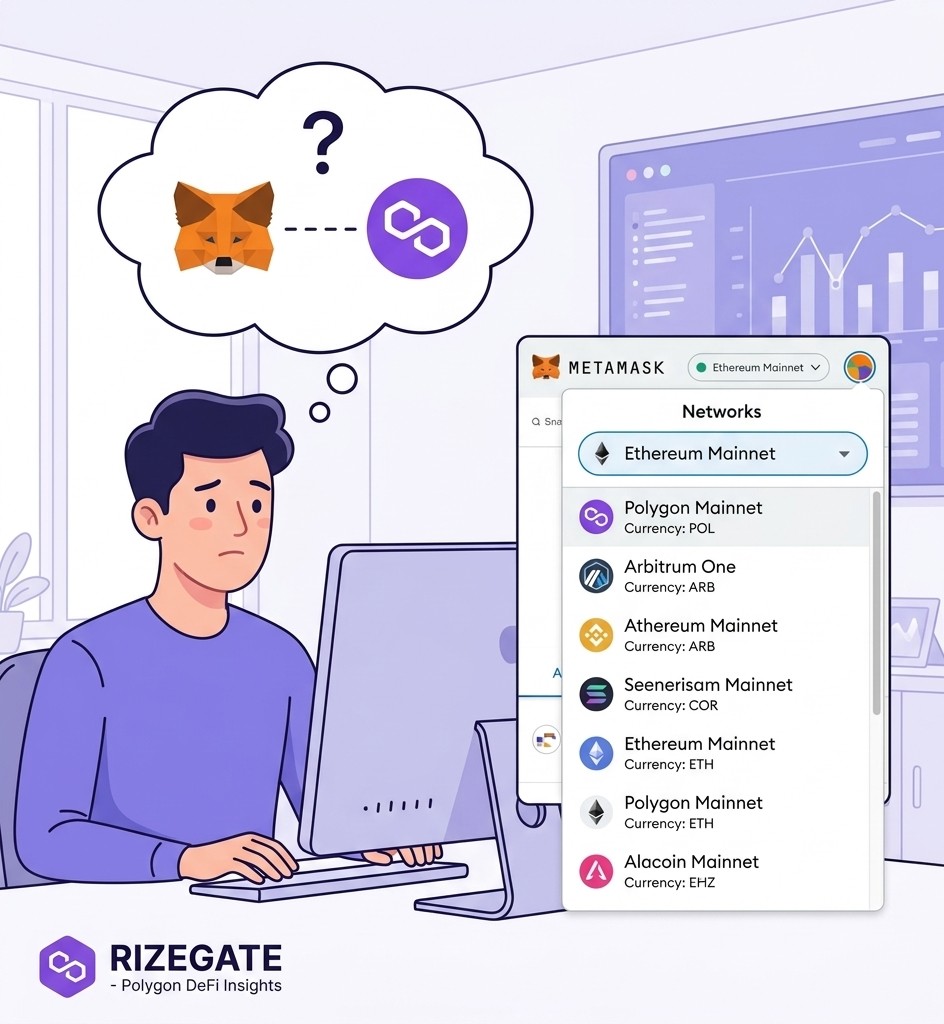
Before I could do anything with RizeCoin, I needed MetaMask connected to Polygon. That sounds simple. It wasn’t. The network list in MetaMask was overwhelming. I knew the name “Ethereum.” I knew the name “Polygon.” But was Polygon inside Ethereum? A separate thing? When I looked at USDC or USDT, those tokens existed on multiple networks — so which version was I dealing with? And then inside Polygon there was Mainnet and Testnet. What did that mean?
I ended up just selecting Polygon and moving forward. It worked — but I didn’t understand why. This guide is the clear explanation I needed at that moment.
- Is Polygon Inside Ethereum?
- Mainnet vs Testnet — What’s the Difference
- Before You Start
- Step 1 — Open MetaMask and Find the Network Selector
- Step 2 — Check if Polygon is Already Listed
- Step 3 — Add Polygon Manually
- Step 4 — Verify You’re on the Right Network
- Step 5 — Check Your POL Balance
- About Tokens on Multiple Networks — The Confusion Explained
- How to Check You’re Actually on Polygon
- One More Layer of Protection
Is Polygon Inside Ethereum?
The question I couldn’t answer at first: Is Polygon inside Ethereum, or is it its own separate network?
The answer: Polygon is its own separate blockchain network. It is not inside Ethereum. But it is designed to work alongside Ethereum — you can move assets between them using a bridge. They are independent networks that can communicate with each other.
USDC on Polygon and USDC on Ethereum are the same dollar value, but they exist on different networks. Sending Polygon USDC to an Ethereum address without bridging it first is a mistake that can cost you the funds. Always check which network you are on before sending anything.
Mainnet vs Testnet — What’s the Difference
Inside Polygon, MetaMask shows two options: Polygon Mainnet and sometimes Polygon Amoy Testnet. This was the second thing that confused me.
Polygon Amoy Testnet: A practice network. Fake tokens with no real value. You can test transactions, deploy contracts, and make mistakes without spending anything real. Good for learning before touching real funds.
For everything in this guide — buying POL, swapping tokens, adding liquidity — you want Polygon Mainnet. If you accidentally send real funds on the Testnet, they have no value there.
Before You Start
You need MetaMask installed. If you haven’t done that yet, download it from metamask.io only — not from any other source. Fake MetaMask extensions exist and will steal your funds.
Step 1 — Open MetaMask and Find the Network Selector
Open MetaMask by clicking the extension icon in your browser, or opening the app on mobile. At the top of the MetaMask window, you’ll see the current network name — by default it shows “Ethereum Mainnet.” Click on that network name. A dropdown appears showing your available networks.
Step 2 — Check if Polygon is Already Listed
In the network dropdown, look for “Polygon Mainnet.” MetaMask now includes Polygon in its default network list, so it may already be there. If you see it, click it. Your MetaMask is now connected to Polygon. You can skip to Step 4.
Step 3 — Add Polygon Manually
If Polygon isn’t in your list, you need to add it manually. Click “Add a network” at the bottom of the dropdown, then “Add a network manually,” and enter these details exactly:
New RPC URL: https://polygon-rpc.com
Chain ID: 137
Currency Symbol: POL
Block Explorer URL: https://polygonscan.com
Click Save. The fastest alternative: go to chainlist.org, search for “Polygon,” and click “Add to MetaMask.” It fills in all the details automatically. This is what I use now.
Step 4 — Verify You’re on the Right Network
After selecting Polygon Mainnet, check the top of your MetaMask window. It should now show “Polygon Mainnet” with the purple Polygon logo. Your wallet address stays the same — the same 0x… format you use on Ethereum. What changes is which network your transactions go through and which tokens are visible.
Step 5 — Check Your POL Balance
Once connected to Polygon Mainnet, your MetaMask shows your POL balance. If you just set up the wallet, this will be zero. POL is the gas token for Polygon — you need a small amount to pay for any transaction. Without POL, nothing works.
Don’t have POL yet?
MEXC is the exchange I use. Buy POL and send it directly to your MetaMask wallet on Polygon.
About Tokens on Multiple Networks — The Confusion Explained
When MetaMask is connected to Polygon Mainnet, it shows you only the Polygon versions of those tokens. When connected to Ethereum, it shows you the Ethereum versions.
How I think about it now: Each blockchain network is a separate country. USDC is like a currency that exists in multiple countries — but the versions aren’t directly interchangeable without going through an exchange (bridge). MetaMask is your wallet. Switching networks in MetaMask is like telling your wallet which country’s financial system you’re currently operating in. Your wallet address stays the same — just like your name doesn’t change when you travel — but the assets visible and the transactions possible depend on which network you’re connected to.
Once I understood that, the confusion cleared up.
How to Check You’re Actually on Polygon
If you’re ever unsure whether a transaction went through on the right network, go to PolygonScan and search your wallet address. PolygonScan only shows Polygon transactions — if your transaction appears there, it happened on Polygon.
One More Layer of Protection
MetaMask is a software wallet — your private key lives on your computer. For significant holdings you plan to keep long-term, a hardware wallet keeps your private key completely offline and physically separate from any online attack.
Holding significant amounts on Polygon?
A hardware wallet keeps your private key offline. Buy only from the official store — never from third-party marketplaces.


Comments